How it works
What Ambipath did between Marcus’s last order and his next.
Marcus, a father of three in Lincoln Park, orders the same family dinner from Roost every other Friday. The loop below ran for him the way it runs for every customer, in five steps, each one inside the objective Roost’s team wrote.
Every result feeds the next decision
Learn the journey
Ambipath reads how each customer moves through your app, joined with what your CRM and catalog know, and finds where journeys stall.
Marcus, 12 weeks in Roost
He rebuilds a five-line family order by hand every time he orders. One visit ended when he was interrupted, and another when he gave up applying a reward.
Reads screens, taps and the events Roost declared, plus orders and points from Roost’s CRM connector.
Decide whether and when
It picks the objective that applies to this customer, then decides whether now is the moment. Often the answer is to wait.
Sunday 8:00 PM Held
Marcus ordered his usual two days ago, usually waits about 15 days between orders, and has placed all 6 orders on a Friday around 5:36 PM.
Objective Their usual, in one tap. One notification a week, none on a day he ordered.
Reach one person
It writes to the customer about their own order, at an hour their own history says they read.
Friday 4:45 PM Sent
All 6 of Marcus’s orders were the same one, placed on a Friday around 5:36 PM, so 4:45 PM on a Friday lands just before they would build it by hand, and they have no saved favorite yet.
Delivered through Roost’s own push provider, with a link to the screen below.
Build the screens
It builds the screens the notification opens from the components Roost registered, and binds every price from Roost’s systems.
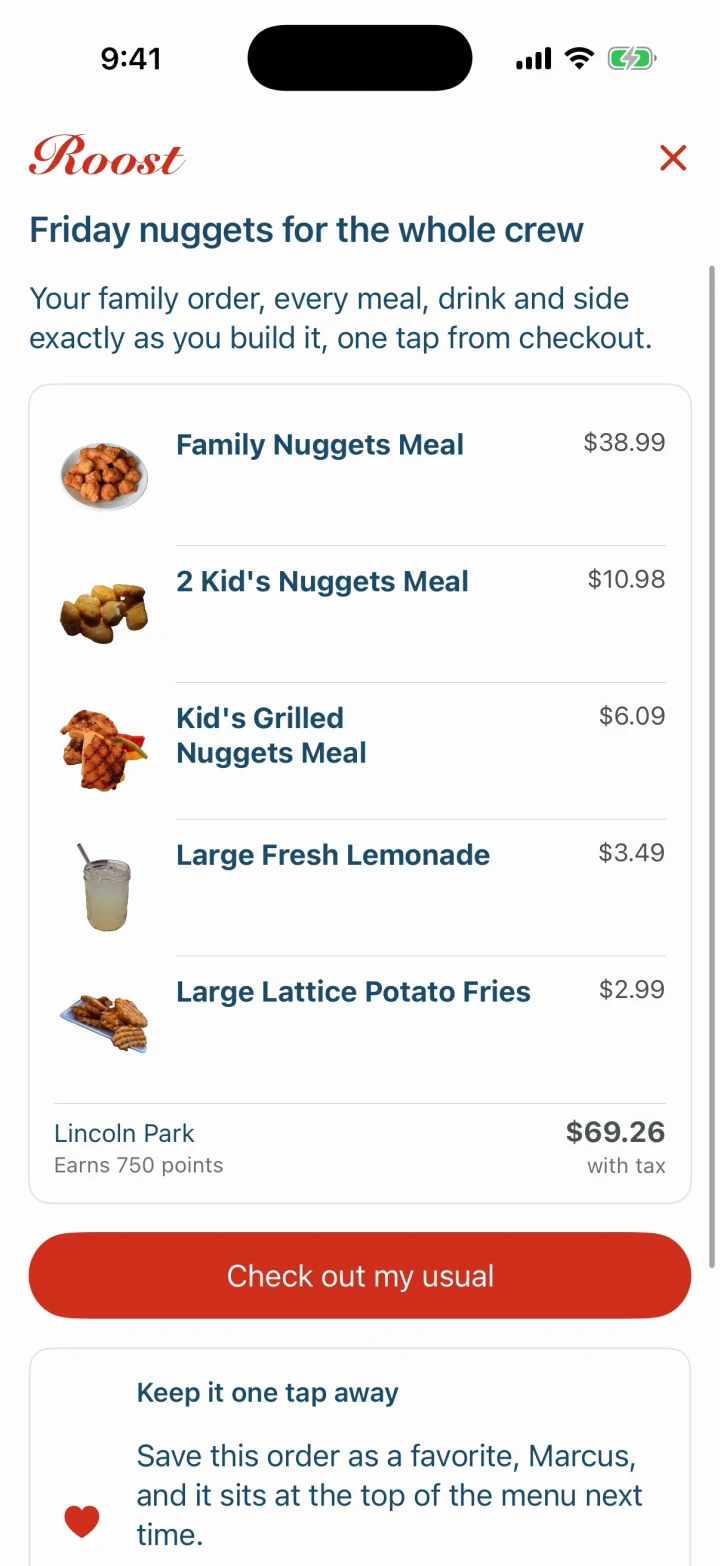
His family order, five lines from Lincoln Park at $69.26 that earn 750 points. One button takes him to Roost’s checkout with the restaurant and card filled in. The first screen was built before the notification went out, so the tap never waits.
Measure and feed the next decision
Every flow is checked before it ships and every objective runs against a holdout. The result goes back into the journey map.
- Every price came from Roost’s catalog, none from the model
- No phrase from the objective’s never-say list
- Order placed three taps after the notification
- Recorded against the objective, and his next Friday starts from it
Studio
Your growth lead writes each objective.
Each objective sets who it is for, how often they may hear from you, what every flow must offer and the words it may never use. Ambipath works inside those limits, and a flow that states a price your catalog did not supply is rejected before any customer sees it.
- Review first
- Approve every flow before it goes live, for as long as you want.
- Choose the share
- Set the share of customers Ambipath works with, down to zero, at any time.
- Holdout from day one
- Every objective measures against customers Ambipath leaves alone.
- Falls back to your app
- If Ambipath cannot answer, the link opens the screen your app would have opened.
Spend the points they have
“A member holding points they have not spent, who has stopped ordering, should see exactly what those points buy in their own usual order, and be one tap from it with the reward already applied.”
- Who
points ≥ 450redeemedLast60Days = 0daysSinceLastOrder ≥ 14- Must carry
reorderorredeemReward- How often
- 1 notification in 14 days
- Never says
- expiringuse it or lose itlast chancewe miss you
- Measured by
- A redemption, then an order
Questions
What growth leads ask about the loop
- Will it message customers too often?
- It sends when it has a specific reason for one person, and it reduces contact for anyone whose responses fall. You can cap notifications per customer each week and set quiet hours per market, and those limits always win.
- When does it stay quiet?
- When a customer is in the middle of an order, has already ordered that day or has nothing specific to be told. It also waits when the moment is wrong. Priya’s breakfast notification was held on a Sunday evening, because neither restaurant could take her order until Monday at 7:01 AM.
- Will the screens look like our app?
- Every screen is made of the components you register, set in your own typefaces and colors. Screens can combine them in arrangements your app has not shipped, such as a usual order and the reward its points cover on one screen. One setting keeps flows inside patterns you have already shipped.
- How long until the first result?
- The first map of your app’s journeys is ready two to three weeks after the SDK ships. For a weekly order, a holdout reads four to six weeks after the first notification.
- Can it start journeys a customer has never taken?
- Yes. It learns which journeys turn a customer into a regular, such as saving a favorite or a first reward, and brings customers who fit that pattern into them.
- Who on our team runs it?
- The growth or lifecycle lead, whoever owns retention. They review the journeys Ambipath found, write objectives and read results in Studio. Engineering ships one release and afterwards only adds new components.